
Fulfills:
BIOS 475/475L OR NRES 471/871 + BIOS 875/875L
NOTE: Avian Biology, BIOS 475 and NRES 471, is a 3 credit course. We add 475L (1 credit) to make it 4 credits total. You will need to enroll in both.
Prerequisites:
LIFE 121 and LIFE 121L
About the Instructor:
Allison Johnson - I am a research assistant professor at the University of Nebraska-Lincoln working for the School of Natural Resources as an avian biologist. I completed my PhD at the University of Chicago but got my start in ornithology in western Nebraska. I spent most winters growing up watching sandhill cranes migrate through the Platte River Basin, and several summers at Cedar Point Biological Station studying cliff swallows. These experiences instilled in me a love of ornithology, and of Great Plains birds in particular.
My research addresses the evolutionary causes and consequences of social behavior in avian systems. I use a combination of field observation, experimentation, phylogenetic analysis, and social network modeling to understand sociality. I am investigating the costs and benefits of conspecific sociality and heterospecific sociality using long-term population monitoring of splendid and purple-backed fairywrens in South Australia. Specifically, I am interested in how social interaction both within and between species impacts survival, reproductive behavior, and foraging behavior, as well as how communication and individual recognition are used to mediate such varied social interactions. From a modeling perspective, I am interested in identifying whether or not simple rules of social attachment and dispersal can generate the complex social organizations seen in nature. I combine this theoretical approach with long-term data on the cooperatively-breeding fairywrens to understand what rules may generate variation in sociality across species. I am also beginning a project to understand how environment, resource limitation, and social benefits interact to generate variation in onset of moult and social group size and composition in Australian fairywrens. The Fairywren Project, cofounded by Joe Welklin at Cornell University, combines observations submitted by citizen scientists from across the Australian continent with long-term data collected by university labs. We are compiling these data from observations of multiple fairywren species to elucidate broad scale patterns between environment and sociality.
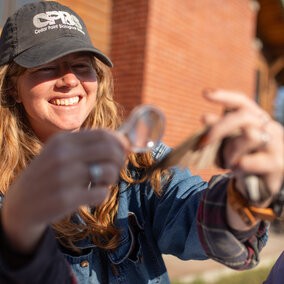
Dr. Allison Johnson studying a bird wing with a magnifying glass.
-Photo by Carlee Koehler Moates
Course Description:
This course will introduce students to the biology of birds through a combination of lectures, field trips, and group research projects. We will discuss a variety of topics including morphology, physiology, evolution, and ecology, with a special emphasis on behavior. Lectures will be held mostly in the afternoons when local birds are less active. We will spend most mornings and some full days in the field learning bird identification, practicing field techniques, and completing group projects. Students will be introduced to techniques including bird banding, acoustic recording and analysis, and behavioral observation. Optional mist netting of birds on the CPBS campus in the early mornings or over the weekends will provide students a unique opportunity to see birds up close and will offer the chance to participate in monitoring of the CPBS bird populations. Group projects will involve studying local breeding birds and can be adapted to fit students’ specific interests with the potential to focus on parental care, territoriality and aggression, foraging behavior, and communication. We will explore a variety of local habitats, including grasslands, wetlands, and the mountains to observe the diversity and habitat specificity of avifauna. Trips will include visits to Crescent Lake National Wildlife Refuge, Pawnee National Grasslands, and an optional overnight excursion to the Rockies. The cost of these trips is largely covered by CPBS, excepting some small fees and spending money.
-
 Measuring bird time.Carlee Koehler Moates
 -
 "They got me again."Carlee Koehler Moates
 -
 Inspection of a wing.Carlee Koehler Moates
 -
 Class is in session!Carlee Koehler Moates
 -
 Student learning how to remove a bird from a mist net without harming it.Carlee Koehler Moates
 -
 Student studying bird in their hand.Carlee Koehler Moates
 -
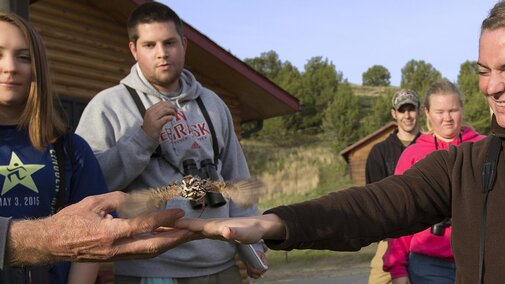 Hands-on learning -University Communications
 -
 Learning how to gently take measurements for research. -CPBS archive
 -
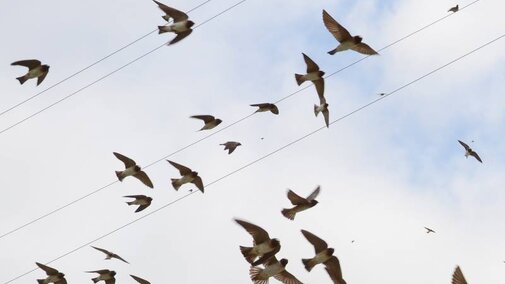 Flock of birds around powerlines.
 -
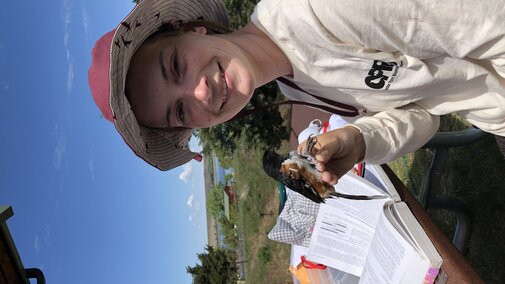 Student with bird.
 -
 An owl in a student's hand.
 -
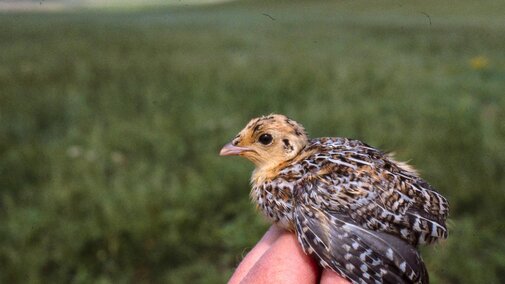 Fledgling in student hand.
 -
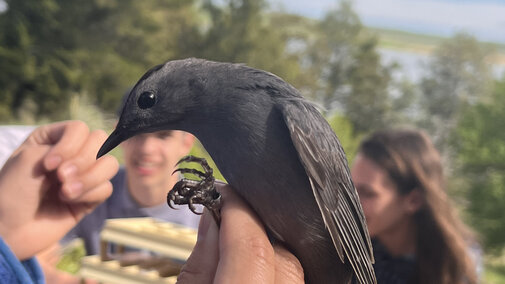 Bird in student hand while identifying characteristics of species up close.
Ready to sign up for this class?
Head to our Marketplace page to pay the deposit that guarantees your seat in this class.